The evolution of the energy transition has made Battery Energy Storage Systems (BESS) fundamental assets – not only for optimizing self-consumption from renewable sources, but above all for the resilience of grid infrastructure. In the commercial and industrial (C&I) sector, BESS units play a crucial role as advanced backup solutions.
For companies operating uninterruptible critical loads — such as data centers, continuous chemical processes, or hospital departments – integrating a BESS ensures operational continuity, eliminating the risks of micro-interruptions (flicker) or blackouts that would cause substantial economic losses and equipment damage.
Through peak shaving and load shifting functions, combined with response times on the order of milliseconds, these systems stabilize the internal grid, guaranteeing Power Quality.
At the heart of managing these machines is the EMS (Energy Management System), the software “brain” that oversees energy flows, communicates with grid nodes, and optimizes charge/discharge cycles based on predictive algorithms and market logic. Currently, the technology landscape is divided into three hardware macro-categories, differentiated by modularity, capacity, and installation flexibility.
Modular, Stackable BESS
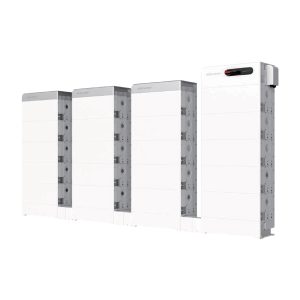
This category represents the ideal solution for the C&I sector, which requires flexibility and ease of sizing. Unlike single-block units, this architecture features structurally separate hardware components: the power conversion unit (inverter) and the battery modules (usually Lithium Iron Phosphate chemistry, LFP) are installed individually but are designed to integrate natively into a single communication and thermal management ecosystem.
- Inverter power: these systems use three-phase hybrid inverters, DC-coupled or AC-coupled, with scalable rated power typically ranging from 25–30 kW to 100–125 kW per single unit, often paralleled to reach overall power outputs on the order of a MW.
- Storage capacity: capacity is highly scalable thanks to the independent-module design. Each battery pack typically has a rated capacity between 5 and 12 kWh. By connecting multiple modules in series on a single tower or paralleling multiple towers, the system can configure overall storage clusters ranging from 5 kWh up to 250 kWh per single inverter group. The dedicated EMS manages energy optimization at the individual module level, preventing the aging of a single cell from penalizing the entire bank.
Cabinet BESS (engineered enclosures)
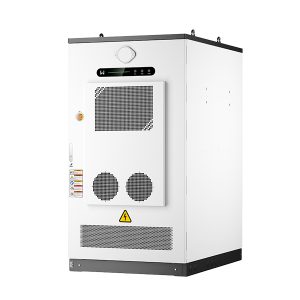
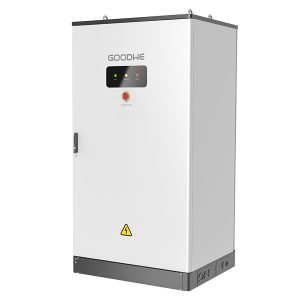
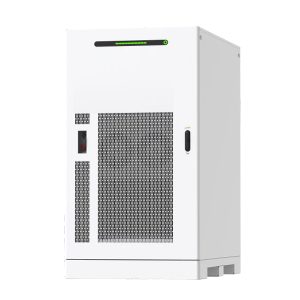
Cabinet systems represent the standard solution for the mid-sized commercial and industrial (C&I) segment. These are pre-assembled, certified rack enclosures for outdoor or indoor installation (with high protection ratings such as IP55), integrating batteries, fire safety systems, and thermal management inside a single unit.
- Power and capacity: the power conversion section (PCS), integrated or tightly coupled to the cabinet, generally ranges from 50 kW to 125 kW. The internal energy capacity of the racks typically varies from 50 kWh up to 250 kWh per single cabinet, with the possibility of connecting multiple cabinets in parallel to meet larger-scale business needs. Thermal control is handled by forced-air or liquid HVAC systems to stabilize the cells.
- STS (Static Transfer Switch) integration: the management of electrical continuity during a blackout depends critically on the presence of a static switching device:
- Cabinet WITH STS: the inclusion of a thyristor-based static switch allows the system to continuously monitor grid parameters. In the event of voltage fluctuations or interruptions, the STS disconnects the main line and switches critical loads over to the BESS in under 4–10 milliseconds. This seamless transition prevents computers, servers, and sensitive industrial machinery from shutting down, functioning effectively as a large-scale UPS.
- Cabinet WITHOUT STS: in this configuration, the system lacks the fast semiconductor-based switch. While it can still operate in island mode, the transition from grid to battery power occurs via external mechanical contactors. This results in a slower switching time, typically between 20 and 50 milliseconds (or more), causing a micro-interruption that shuts down electronic loads not protected by local UPS units. This solution is suitable for general-purpose emergency power backup, but not for protecting continuous-cycle industrial loads.
Containerized BESS (utility-scale and large industry)
For energy-intensive industries, large renewable generation plants, and grid-stability services for network operators, the only applicable architecture is the containerized system, mounted on standardized 20- or 40-foot structures.
- Power and capacity: these infrastructures manage centralized or distributed power well in excess of 500 kW, reaching up to several megawatts (MW) via dedicated medium-voltage conversion stations. Energy capacity is massive, starting at 1 MWh and exceeding 4-5 MWh per single container in the latest high-density generation.
- Management characteristics: these systems leverage highly sophisticated liquid cooling technologies and multi-stage safety systems. In this scenario, the EMS is a centralized, industrial-grade software platform that interfaces directly with the plant’s SCADA systems and with transmission system operator (TSO) platforms to operate in dispatching services markets.
-
BESS, GoodWe, Storage Battery
GoodWe BAT-C 208.9 and 261.2 kWh
The GoodWe BAT-C 208.9 and 261.2 kWh are high-voltage lithium battery systems designed for commercial and industrial (C&I) energy storage applications. Featuring 314 Ah battery cells, liquid cooling and advanced safety systems, they can be integrated with GoodWe ET 100 hybrid inverters and the STS system for backup, peak shaving, load management and microgrid applications.
- Nominal capacities of 208.9 and 261.2 kWh
- 314 Ah battery cells
- Intelligent liquid cooling
- Cycle life of ≥10,000 cycles
- IP55 protection rating and integrated fire suppression system
SKU: n/a -
BESS, GoodWe, Storage Battery
GoodWe BAT-C: 61,4 e 112,6 kWh
The GoodWe BAT-C 61.4 and 112.6 kWh are high-voltage battery systems featuring LiFePO4 technology, designed for commercial and industrial energy storage applications. Combined with GoodWe ET hybrid inverters and the STS system, they enable scalable configurations for backup, peak shaving and intelligent load management.
- Nominal capacities of 61.4 and 112.6 kWh
- Usable energy of 60 and 110 kWh
- LiFePO4 (LFP) battery technology
- Up to 4 units connected in parallel
- IP55 protection rating and aerosol fire suppression system
SKU: n/a -
BESS, Huawei, Storage Battery
Huawei LUNA2000 107-215 – C&I BESS storage system with hybrid cooling
The Huawei LUNA2000-(107-215) system is the ideal solution for commercial and industrial installations that require high-capacity energy storage, scalability and maximum safety.
- Available storage capacities: 215 kWh, 161 kWh, 107 kWh
- Charging/discharging power: up to 108 kW
- LFP cells
- Maximum cycle efficiency: 3 % (@ 0.25 C)
- Protection rating: IP55
SKU: n/a -
BESS, Huawei, Storage Battery
Huawei LUNA2000-2507/5015-2S: BESS storage container 2.507/5.015 MWh – 1.254/2.507 MW
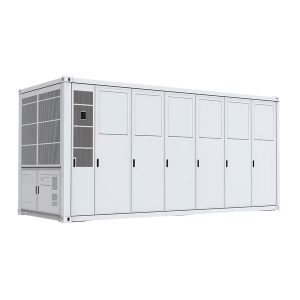 BESS, Huawei, Storage Battery
Huawei LUNA2000-2507/5015-2S: BESS storage container 2.507/5.015 MWh – 1.254/2.507 MW
Huawei liquid-cooled electrochemical storage container from the LUNA2000-2S series, built on Smart String Grid-Forming technology, designed for utility-scale storage and grid-support applications.
- Rated charge/discharge power of a 0.5 C system (1.254 or 2.507 MW depending on the system)
- Nominal energy capacity 2.507 or 5.015 MWh
- Protection degree IP55, C5-Medium anti-corrosion class
- Smart String Grid-Forming technology with ancillary grid services support (black start, voltage and frequency regulation)
SKU: n/a -
BESS, Jinko Solar, Storage Battery
Jinko Solar: SunGiga G2 – 261 kWh – all-in-one cabinet for C&I applications
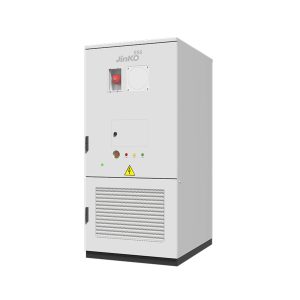 BESS, Jinko Solar, Storage Battery
Jinko Solar: SunGiga G2 – 261 kWh – all-in-one cabinet for C&I applications
All-in-one battery energy storage system Jinko SunGiga G2 JKS-261KLAA-125PLAB-EU-A in a liquid-cooled cabinet, for commercial and industrial (C&I) applications with integrated battery, BMS, PCS and fire protection.
- Nominal capacity 261 kWh
- LFP (LiFePO4) cells of 314 Ah, 832 V voltage
- Nominal AC power 130.5 kW at 400 V
- Liquid cooling, IP55 ingress protection
- Up to 12 units in parallel
SKU: n/a -
BESS, Jinko Solar, Storage Battery
Jinko Solar: SunGiga G2 Plus – 520 kWh – all-in-one cabinet for C&I applications
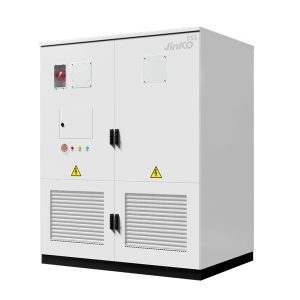 BESS, Jinko Solar, Storage Battery
Jinko Solar: SunGiga G2 Plus – 520 kWh – all-in-one cabinet for C&I applications
Battery energy storage system Jinko Solar SunGiga G2 Plus JKS-520KLAA-125PLAA-EU-A2 in a liquid-cooled cabinet, for large commercial and industrial (C&I) applications with on-grid, off-grid and microgrid operation.
- Nominal energy 522 kWh
- LFP (LiFePO4) cells of 314 Ah, 832 V voltage
- Three-phase output at 400 V
- Liquid cooling, IP55 ingress protection
- Up to 6 units in parallel
SKU: n/a -
BESS, Sigenergy, Storage Battery
Sigenergy SigenStack BAT 12.0 – C&I storage system
ESS by Sigenergy with high energy density, for commercial and industrial plants, potentially able to reach up to 253kWh through the combination of its 12kWh modules.
- Scalability from 4 up to 21 modules (from 48 to 253kWh)
- Column mounting system with 4 to 7 modules each
- Ground-mounted
- IP66
- Fire prevention solution integrated
- Maximum charge/discharge power: 126kW
- To pair with SigenStack BC M2-0.5C-BST (one for each inverter)
SKU: n/a -
BESS, SMA, Storage Battery
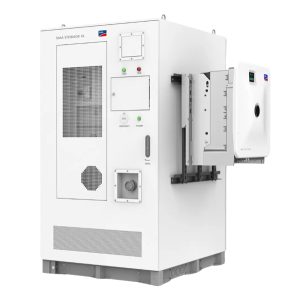
SMA Storage XL Package – Indoor e Outdoor da 89 a 197 kWh
Battery energy storage system (BESS) of the rack type for indoor installations and of the cabinet type for outdoor installations, part of the SMA Commercial Energy Solution. Designed for commercial and industrial projects optimising self-consumption, peak shaving and load management.
- Lithium Iron Phosphate (LFP) cells, nominal voltage 320/384/704 V
- Sunny Tripower Storage X battery inverter, 30 or 50 kW
- IP20 protection rating for the Indoor version and IP55 for the Outdoor version
- Up to 12,000 charging cycles and a 10-year system and capacity warranty
- Available energy capacities: 89/107/197 kWh
SKU: n/a -
BESS, SolarEdge, Storage Battery
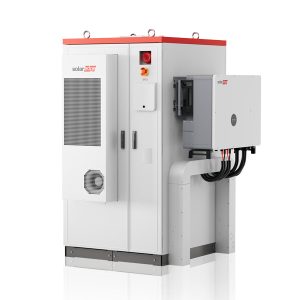
SolarEdge CSS-OD 107 – All-in-One Cabinet for C&I Systems
SolarEdge CSS-OD 107 is a 107 kWh battery energy storage system designed for commercial and industrial (C&I) photovoltaic applications. The solution provides flexible system sizing, smart energy management and seamless integration within the SolarEdge ecosystem.
- 107 kWh capacity per battery cabinet
- 29.9 kW or 49.9 kW battery inverter options
- Modular architecture, scalable up to 2.1 MWh
- Smart energy management with SolarEdge ONE for C&I
- Supports self-consumption, peak shaving and critical load backup
SKU: n/a -
BESS, SolarEdge, Storage Battery
SolarEdge CSS-OD 197: CSS-OU-20 / PCS050 – All-in-One Cabinet for C&I Systems
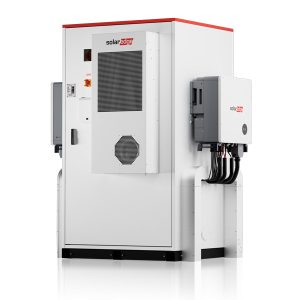 BESS, SolarEdge, Storage Battery
SolarEdge CSS-OD 197: CSS-OU-20 / PCS050 – All-in-One Cabinet for C&I Systems
The SolarEdge CSS-OD 197 is the ideal solution for those looking for a compact, safe and easy-to-install storage system, capable of increasing energy self-sufficiency and reducing grid consumption. Thanks to the SolarEdge ONE EMS, it is possible to manage the stored energy in every use case.
- Total storage capacity: 102.4 kWh
- Maximum charge/discharge power: 50 kW
- Pre-configured inverter and batteries for quick installation.
- Integrated fire protection system
- IP65 protection rating
SKU: n/a