


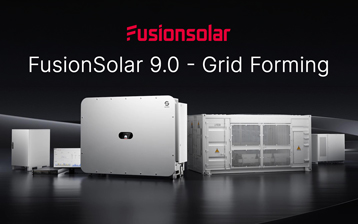
Huawei Digital Power is expanding the applications of Grid-Forming (GFM) technology, extending its capabilities from Energy Storage Systems (ESS) to photovoltaic inverters and integrated PV + ESS solutions. This technological advancement aims to enhance grid stability and facilitate the integration of increasing shares of renewable energy into power systems.
Grid-Forming technology represents one of the most significant developments in modern power systems, particularly for large-scale photovoltaic installations, utility-scale applications, and weak grids characterised by low short-circuit capacity.
What is Grid-Forming technology and how does It work?
Unlike conventional Grid-Following inverters, which synchronise with the voltage and frequency of an existing grid, Grid-Forming inverters are designed to actively contribute to establishing and maintaining grid voltage and frequency.
Through advanced control algorithms, GFM technology enables essential grid-support functions:
- Synthetic inertia: rapid response to frequency deviations, contributing to the dynamic stability of the power system.
- Voltage support: active voltage regulation to mitigate disturbances and maintain stable operating conditions.
- Oscillation damping: reduction of electrical oscillations that could compromise power system stability.
- Disturbance response: ability to support the grid during transient events, within the technical capabilities of the system and applicable grid requirements.
These capabilities are particularly important in weak grids and power systems with high renewable energy penetration.
Huawei extends grid-forming technology from ESS to PV inverters
Huawei Digital Power’s latest innovation focuses on extending Grid-Forming capabilities beyond energy storage systems.
The objective is to deploy this technology across different stages of the energy system, from photovoltaic generation and energy storage to energy management, enabling greater integration between power generation, distribution, and consumption.
Huawei SUN2000-506KTL inverters with grid-forming technology
Among Huawei’s latest technological developments is the SUN2000-506KTL series, which introduces Grid-Forming capabilities into string PV inverters.
This advancement enables inverters to actively contribute to grid stability, offering potential benefits such as:
- Reduction of transient voltage fluctuations.
- Enhanced response to electrical disturbances.
- Improved stability support for grids with low short-circuit capacity.
- Greater integration of photovoltaic generation into power systems with high renewable energy penetration.
The extension of Grid-Forming technology across Huawei’s inverter portfolio represents an important development for utility-scale PV installations and future power system architectures.
Huawei grid-forming energy storage systems: stability and Dynamic Response
Huawei has developed Grid-Forming ESS solutions capable of providing dynamic grid support through advanced Power Conversion System (PCS) control.
These systems can contribute to voltage and frequency stability by delivering synthetic inertia and oscillation damping capabilities.
Huawei 35 kV grid tests: short-circuit disturbance response
Huawei has reported positive results from disturbance response tests conducted on a 35 kV power grid.
According to data released by the manufacturer, the tests demonstrated that:
- The PCS units remained connected to the grid without tripping.
- A current response of up to three times the nominal reference value was achieved within 10 milliseconds.
- The Grid-Forming systems contributed to stabilising electrical conditions during grid disturbances.
These results highlight the potential of Grid-Forming technology in applications involving challenging grid conditions. Actual performance, however, depends on system configuration, converter specifications, and testing conditions.
Grid-forming technology and integrated PV + ESS Systems
The integration of Grid-Forming capabilities into photovoltaic inverters and energy storage systems creates new opportunities for designing advanced power generation and energy management systems.
Key application areas include:
- Utility-scale PV plants: enhanced integration of photovoltaic generation into power grids with high levels of inverter-based resources.
- PV + ESS systems: coordinated operation of photovoltaic generation and energy storage to improve the system’s dynamic response.
- Weak grids: advanced control solutions designed to support electrical stability in grids with low short-circuit strength.
- Microgrids and advanced energy systems: opportunities to develop architectures featuring advanced voltage, frequency, and power flow management.
The adoption of these technologies requires careful assessment of product specifications, operating modes, and applicable grid connection requirements.
Huawei grid-forming: towards a new generation of photovoltaic Power Systems
With the ongoing evolution of its FusionSolar solutions, Huawei Digital Power aims to progressively extend Grid-Forming capabilities across different components of modern energy systems.
The transition from ESS-based Grid-Forming solutions to integrated PV + ESS configurations and photovoltaic inverters represents a significant development for the industry. The ability to actively support grid stability is becoming increasingly important alongside conversion efficiency and energy generation performance.
VP Solar, a B2B distributor of Huawei FusionSolar solutions, supports installers, system designers, and EPC contractors in identifying the most suitable photovoltaic and energy storage technologies for residential, commercial, industrial, and utility-scale projects.
To learn more about Huawei solutions and their applications, contact the VP Solar technical sales team.
-
Accessories Huawei, Huawei, Inverter
Huawei EMMA-A02 Energy Management Assistance
EMMA (Energy Management Assistant) is a device that integrates the functions of a meter, communication, and management of household loads. This last function is undoubtedly the most interesting and distinctive feature of the device.
- Flexible and compatible with various appliances
- Built-in WLAN/FE module
- Compatible with Huawei inverters: SUN2000 2-6KTL-L1, 8-10KTL-LC0, 5-12KTL-M1, 8-20KTL-M2, 12-25KTL-M5, 12-25KTL-MB0
SKU: n/a -
Commercial inverter Huawei, Huawei, Inverter, Photovoltaic inverter
Huawei SUN2000 100 / 115 KTL – M2 – three-phase
 Commercial inverter Huawei, Huawei, Inverter, Photovoltaic inverter
Huawei SUN2000 100 / 115 KTL – M2 – three-phase
Huawei three-phase inverter, ideal solution for commercial and industrial installations.
- 10 MPPT, 20 inputs
- Integrated DC circuit breakers
- IP66
- RS485, MBUS, USB, optional: WiFi, Ethernet, 4G / 3G / 2G
- Available models: 100KTL-M2, 115KTL-M2
SKU: n/a -
Commercial inverter Huawei, Huawei, Huawei, Hybrid inverter, Inverter
Huawei SUN2000 12/15/17/20/25 K-MBO – three-phase hybrid inverter
 Commercial inverter Huawei, Huawei, Huawei, Hybrid inverter, Inverter
Huawei SUN2000 12/15/17/20/25 K-MBO – three-phase hybrid inverter
Three-phase hybrid SUN2000 12/15/17/20/25 K-MBO inverter ideal for C&I systems, with sizes ranging from 12 to 25 kW
- Efficiency up to 98.2
- Weight and footprint (546 x 460 x 228 mm, weight approx. 21kg)
- IP66 degree of protection
SKU: n/a -
Commercial inverter Huawei, Huawei, Inverter, Photovoltaic inverter
Huawei SUN2000 12/15/17/20/25 KTL-M5 – three-phase
 Commercial inverter Huawei, Huawei, Inverter, Photovoltaic inverter
Huawei SUN2000 12/15/17/20/25 KTL-M5 – three-phase
The Huawei SUN2000 M5 three-phase string inverter was created to maximize energy yields in residential and commercial PV systems.
- 2 MPPT (two inputs each)
- RS485, Optional: Ethernet, WiFi, 4G
- IP66 protection rating
- Available sizes: 12/15/17/20/25 KTL-M5
SKU: n/a -
Huawei, Huawei, Hybrid inverter, Inverter, Photovoltaic inverter, Residential inverter Huawei
Huawei SUN2000 2/3/3.68/4/4.6/5/6 KTL-L1 – single-phase hybrid inverter
 Huawei, Huawei, Hybrid inverter, Inverter, Photovoltaic inverter, Residential inverter Huawei
Huawei SUN2000 2/3/3.68/4/4.6/5/6 KTL-L1 – single-phase hybrid inverter
The Huawei SUN2000 KTL-L1 single-phase hybrid inverter was created to maximize the energy self-consumption of your single-phase system and guarantees high yields and reliable performance.
- 2 MPPT
- RS485, Optional: Ethernet, WiFi, 4G
- Integrated AFCI
- IP65 protection rating
- Available sizes: 2/3/3.68/4/5/6 KTL-L1
SKU: n/a -
Commercial inverter Huawei, Huawei, Inverter, Photovoltaic inverter
Huawei SUN2000 215 KTL – H0 & H3 – three-phase inverter
 Commercial inverter Huawei, Huawei, Inverter, Photovoltaic inverter
Huawei SUN2000 215 KTL – H0 & H3 – three-phase inverter
Three-phase string inverter for utility scale applications.
- Number of MPPTs: 9 (H0) or 3 (H3)
- Maximum input voltage: 1500 V
- AC output voltage: 800 V 3P + PE
- Integrated DC circuit breakers
- IP 66
- RS485, MBUS, USB, optional: WiFi, Ethernet, 4G / 3G / 2G (with SmartLogger 3000A)
- Available models: 215KTL-H0 / 215KTL-H3
SKU: n/a -
Commercial inverter Huawei, Huawei, Huawei, Hybrid inverter, Inverter, Photovoltaic inverter, Residential inverter Huawei
Huawei SUN2000 3/4/5/6/8/10 KTL-M1-HC – three-phase hybrid inverter
 Commercial inverter Huawei, Huawei, Huawei, Hybrid inverter, Inverter, Photovoltaic inverter, Residential inverter Huawei
Huawei SUN2000 3/4/5/6/8/10 KTL-M1-HC – three-phase hybrid inverter
The Huawei SUN2000 KTL-M1-HC three-phase hybrid inverter is an efficient and elegant product, created to maximize the energy consumption of your three-phase system.
- Weight and size reduced (525X470X146.5 mm, weight about 17kg)
- Efficiency up to 98.6%
- IP65 protection with natural cooling
- Available sizes : 3/4/5/6/8/10 KTL-M1-HC
SKU: n/a -
Commercial inverter Huawei, Huawei, Inverter, Photovoltaic inverter
Huawei SUN2000 30/36/40/50 KTL-M3
 Commercial inverter Huawei, Huawei, Inverter, Photovoltaic inverter
Huawei SUN2000 30/36/40/50 KTL-M3
Commercial Huawei inverter with three-phase output, ideal solution for new installations.
- 4 MPPT, 8 inputs
- Maximum input voltage: 1,100V
- Integrated DC circuit breaker
- Available models: 30 KTL-M3, 36 KTL-M3, 40 KTL-M3, 50 KTL-M3
SKU: n/a -
Commercial inverter Huawei, Huawei, Inverter, Photovoltaic inverter
Huawei SUN2000 330 KTL – H1 – three-phase inverter
 Commercial inverter Huawei, Huawei, Inverter, Photovoltaic inverter
Huawei SUN2000 330 KTL – H1 – three-phase inverter
With this three-phase string inverter, Huawei wanted to create the perfect product for large photovoltaic systems.
- 6 MPPTs
- Number of inputs per MPPT: 4/5/5/4/5/5
- AC output voltage: 800 V 3P + PE
- Integrated DC circuit breakers
- IP66
- RS485, MBUS, USB
SKU: n/a

