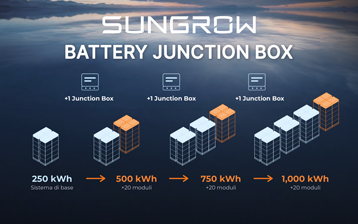
The Sungrow Battery Junction Box extends the configuration options for PowerKeeper energy storage, allowing multiple battery strings to be connected in parallel and providing a total capacity of up to 1,000 kWh per inverter. The solution is designed for commercial and industrial (C&I) applications, where energy requirements can evolve as business operations develop.
The increasing deployment of high-capacity energy storage systems calls for more flexible, scalable and reliable solutions. In this context, the Battery Junction Box allows a system to be sized for current requirements while making provision for subsequent expansion.
The modular PowerKeeper architecture therefore enables installers, system designers and EPC contractors to plan storage expansion around energy consumption, the introduction of new loads and the company’s energy management strategies.
Modular expansion: from 250 kWh to 1 MWh
The Battery Junction Box allows multiple PowerKeeper battery strings to be connected in parallel, increasing the installed storage capacity associated with a single inverter.
| Configuration | Battery strings connected in parallel | Indicative maximum capacity |
| Without a Battery Junction Box | 1 | 250 kWh |
| 1 Battery Junction Box | 2 | 500 kWh |
| 2 Battery Junction Boxes | 3 | 750 kWh |
| 3 Battery Junction Boxes | 4 | 1,000 kWh |
The capacities shown are rounded figures: the PowerKeeper ST250CF configuration has a nominal capacity of 249.6 kWh. Sungrow documentation identifies the Junction Box as model SJC160-02.
This modular approach supports phased investment: a business can install the capacity it needs today and plan further expansion, increasing the capacity of an approximately 250 kWh configuration by up to four times, subject to the manufacturer’s compatibility requirements.
Benefits for installers, system designers and businesses
Phased system sizing and investment
The ability to expand storage capacity allows investment to be aligned with changing business requirements. For system designers, this means assessing the space, electrical connections and provisions required for future capacity increases from the outset.
Flexibility for new installations and retrofit projects
Sungrow describes PowerKeeper as suitable for both new projects and existing installations. For retrofit applications, integration must be assessed against the existing electrical architecture, inverter and control systems.
More energy available for business loads
Adding battery strings increases the amount of energy that can be stored and can extend the period for which loads are supplied. However, operational continuity and backup capability depend on the overall system configuration, the inverter’s functions and the requirements of critical loads.
Furthermore, increasing energy capacity in kWh does not automatically increase power output in kW: these two parameters must be sized separately.
Integration within the PowerKeeper ecosystem
The Junction Box is a dedicated component of the PowerKeeper architecture. The system features a pre-assembled design with simplified wiring, which Sungrow highlights as helping to reduce installation time. Any expansion must nevertheless follow the manufacturer’s wiring diagrams and procedures.
Battery Junction Box technical specifications
For model SJC160-02, the Sungrow datasheet specifies:
- Maximum voltage: 1,000 V DC.
- Rated current: 162.5 A per input and 200 A at the output.
- Protection devices: fuses and a DC isolator.
- Environmental protection: IP66 ingress protection rating and C5 corrosion resistance classification.
- Installation: wall-mounted, with a maximum weight of 12 kg.
For installers and EPC contractors, scalability becomes a practical system design consideration: making provision for future expansion today allows increases in energy consumption to be addressed through planned upgrades.
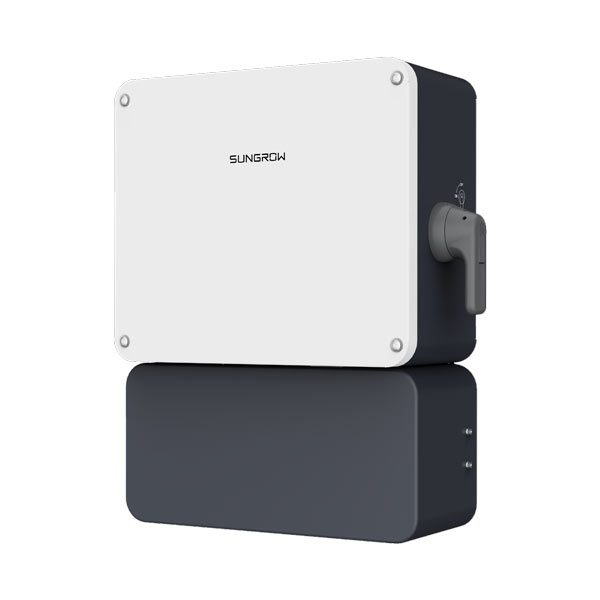
Sungrow Battery Junction Box per SH50-80-125CX – SJC160-02 | A0ST7151
The Sungrow Battery Junction Box for SH50-80-125CX, product code A0ST7151, enables PowerKeeper storage capacity expansion in commercial and industrial applications. It allows multiple battery strings to be connected in parallel, providing an indicative total capacity of up to 1,000 kWh per inverter, in accordance with the configurations specified by the manufacturer.
- Modular expansion: connection of two, three or four PowerKeeper battery strings using one, two or three Junction Boxes respectively.
- Phased system sizing: storage capacity can be expanded to accommodate changes in the site’s energy requirements.
- Integrated protection: fuses and a DC isolator.
- Wall-mounted installation: compact design with a maximum weight of 12 kg.
- Environmental protection: IP66 ingress protection rating and C5 corrosion resistance classification.
Datasheet English
Complete documentation
Storage configurations
| Number of Junction Boxes | Battery strings connected in parallel | Indicative maximum capacity |
|---|---|---|
| 1 | 2 | 500 kWh |
| 2 | 3 | 750 kWh |
| 3 | 4 | 1,000 kWh |
Capacities are rounded figures based on battery strings of approximately 250 kWh. The PowerKeeper ST250CF configuration has a nominal capacity of 249.6 kWh.
Technical specifications
| Parameter | Specification |
|---|---|
| Product designation | Battery Junction Box for SH50-80-125CX |
| Product code | A0ST7151 |
| Model specified in Sungrow documentation | SJC160-02 |
| Battery storage system | Sungrow PowerKeeper |
| Maximum DC voltage | 1,000 V |
| Rated current per input | 162.5 A |
| Rated output current | 200 A |
| Protection devices | Fuses and DC isolator |
| Ingress protection rating | IP66 |
| Corrosion resistance classification | C5 |
| Dimensions, W × H × D | 350 × 411 × 185 mm |
| Weight | ≤ 12 kg |
| Mounting | Wall-mounted |
The electrical and mechanical specifications refer to model SJC160-02, as listed in the Sungrow datasheet.
Applications and system sizing considerations
The Junction Box allows the storage system to be designed for future expansion, accommodating increased production loads or greater energy demand during periods without photovoltaic generation.
Increasing energy capacity in kWh does not automatically increase power output in kW. System sizing must take into account inverter limits, electrical connections and permitted configurations. Backup performance depends on the complete system configuration and the loads to be supplied.
Related products
-
Inverter, Photovoltaic inverter, Sungrow, Residential inverter Sungrow, Commercial inverter Sungrow
Sungrow SG 5.0/6.0/7.0/8.0/10/12/15/17/20 RT
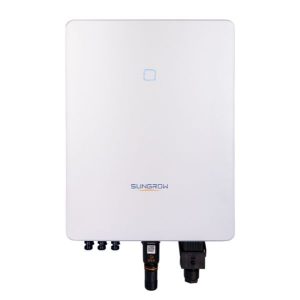 Inverter, Photovoltaic inverter, Sungrow, Residential inverter Sungrow, Commercial inverter Sungrow
Sungrow SG 5.0/6.0/7.0/8.0/10/12/15/17/20 RT
This range of three-phase string inverters produced by Sungrow is ideal for small and medium-sized residential and commercial systems. These inverters are able to offer high efficiency, without sacrificing smart management, making everything safe and easy to use.
- 2 MPPT
- IP65
- Plug and play connector on the AC side and MC4 on the DC side
- Wlan, Ethernet
- Available sizes: SG5.0RT, SG6.0RT, SG8.0RT, SG10RT, SG12RT, SG15RT, SG17RT, SG20RT.
SKU: n/a -
Storage Battery, Sungrow
Sungrow SBS050
The plug&play system and the thin design make the SBS050 battery by Sungrow a simple and compact storage solution for all single-phase photovoltaic plants.
- Battery module capacity: 5.12kWh
- Expandable system that can reach up to 20.48kWh, with 4 modules in parallel
- IP65
- 10-year warranty
- Ground-mounted or wall-mounted
SKU: n/a -
Storage Battery, Sungrow
Sungrow SBH 100-400 – HV battery
Sungrow SBH100-400 represents a reliable and versatile energy storage solution, combining high power, advanced safety and modular flexibility.
- Single module capacity: 5 kWh
- LFP batteries
- Stackable system (up to 8 modules in parallel)
- IP55
- 10-year warranty
SKU: n/a -
Inverter, Photovoltaic inverter, Sungrow, Commercial inverter Sungrow
Sungrow SG 110 CX
The Sungrow SG110CX 3-phase inverter is an efficient and reliable solution for commercial and industrial PV systems.
- 9 MPPT (2 inputs each)
- Arc fault circuit interrupter (AFCI)
- Built-in DC circuit breaker
- IP66, C5
- RS485, Optional: WLAN, Ethernet
- 5-year warranty (extendable up to 10 years)
SKU: n/a