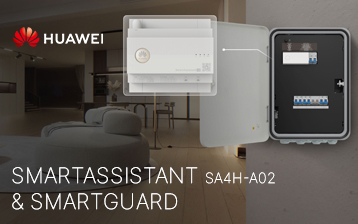
In the residential solar PV and energy storage market, Huawei has introduced two solutions designed to maximise self-consumption and ensure uninterrupted power supply during grid outages: SmartAssistant SA4H-A02 (EMMA) and SmartGuard.
Integrated with Huawei inverters and LUNA2000 battery storage systems, these devices enable intelligent home energy management, improving overall system efficiency while increasing energy independence from the grid.
Huawei SmartAssistant SA4H-A02: Intelligent Home Energy Management
The Huawei SmartAssistant SA4H-A02 (EMMA) is Huawei’s latest DIN-rail-mounted energy management system, developed to centralise monitoring, communication and household load control.
Unlike conventional communication dongles, SmartAssistant integrates advanced metering and energy management functions, providing real-time monitoring of energy flows with Class 1 measurement accuracy (±1%).
Key Features of Huawei SmartAssistant SA4H-A02
- Cascade connection of up to three Huawei single-phase or three-phase inverters via RS485 communication.
- Management of up to two Huawei Smart Charger EV charging stations.
- Integration with SG-Ready heat pumps.
- Control of up to 20 Shelly smart devices for household load management.
- Native communication with the Huawei FusionSolar ecosystem.
Optimising Self-Consumption with predictive energy management
One of the key advantages of SmartAssistant is EMMA (Energy Management Assistant), Huawei’s intelligent energy management algorithm.
By analysing historical consumption data together with weather forecasts, EMMA optimises battery charging and discharging strategies, ensuring that excess solar generation is prioritised for the Huawei LUNA2000 battery, electric vehicle charging or selected household loads, rather than being exported to the grid.
This predictive approach helps maximise PV self-consumption while improving overall energy efficiency.
Huawei SmartGuard: automatic whole-home backup
The Huawei SmartGuard range represents Huawei’s latest generation of backup solutions for residential photovoltaic systems.
In addition to integrating all SmartAssistant SA4H-A02 functions, SmartGuard enables a true Whole-Home Backup solution, maintaining power to the entire property during grid failures without requiring additional backup distribution boards or dedicated load separation.
The unit supports a maximum through-current of 63 A, providing safe and fully automatic switching between grid-connected and backup operating modes.
SmartGuard-63A-S0: single-phase version
The SmartGuard-63A-S0 is designed for 230 V single-phase installations and offers:
- Rated current up to 63 A.
- Automatic transfer to backup mode in less than 20 ms.
- Seamless operation for sensitive loads such as computers, broadband routers and home automation systems.
SmartGuard-63A-T0: three-phase version
The SmartGuard-63A-T0 has been developed for 400 V three-phase systems and provides:
- Three-phase backup when paired with Huawei MAP0 inverters.
- Switching time below 20 ms with MAP0 inverters.
- Single-phase backup operation when used with Huawei M1 and MB0 inverter series.
- Integration with external diesel generators for off-grid applications.
Reliability and energy security
Both SmartGuard models include a manual mechanical bypass, allowing the household to remain directly connected to the utility grid even in the unlikely event of an internal switching system failure.
With an IP55 protection rating for outdoor installation and comprehensive communication interfaces including LAN, WAN, WLAN and RS485, SmartGuard serves as the core of Huawei’s residential energy resilience solution.
Why choose Huawei SmartAssistant and SmartGuard?
Combining SmartAssistant SA4H-A02, SmartGuard, Huawei inverters and LUNA2000 battery storage creates a fully integrated residential energy management system capable of:
- Maximising solar self-consumption.
- Reducing dependence on the electricity grid.
- Intelligently managing household electrical loads.
- Ensuring uninterrupted power supply during blackouts.
- Improving the overall efficiency of residential PV systems with battery storage.
Huawei’s latest solutions demonstrate how modern Energy Storage Systems (ESS) have evolved beyond battery storage, becoming intelligent energy management platforms capable of optimising production, consumption and backup to deliver greater energy independence for homeowners.