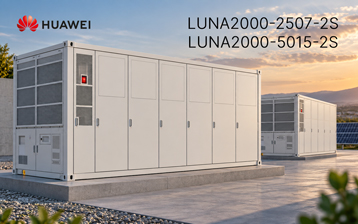
The Huawei LUNA2000-5015-2S and LUNA2000-2507-2S are containerised BESS solutions with capacities of 5,015 kWh and 2,507 kWh respectively, designed for C&I and utility-scale PV installations.
One of the key advantages for designers and EPCs is the ability to size power and storage capacity independently. The power-to-energy ratio is not determined solely by the container, but depends on the number of Huawei LUNA2000-213KTL-H0 Smart PCS units paired with the system.
This architecture allows the BESS to be configured according to the site’s load profile and application: from peak shaving requiring high charge and discharge power to configurations providing close to 8 hours of discharge duration.
Huawei LUNA2000: how many PCS are required for 2, 4 or 8 hours of storage?
Each LUNA2000-213KTL-H0 Smart PCS delivers 213 kW at 40°C and 192 kW at 50°C. When sizing the system, designers must therefore also take into account derating at higher temperatures, which can reduce the available AC power by approximately 10%.
Both systems support a maximum C-rate of 0.5 CP, corresponding to a maximum power of approximately 1,253.5 kW for the LUNA2000-2507-2S and 2,507.5 kW for the LUNA2000-5015-2S.
| BESS container | No. of LUNA2000-213KTL-H0 PCS | AC power at 40°C | P/E ratio | Duration at full power |
| LUNA2000-2507-2S – 2,507 kWh | 3 | 639 kW | 0.25 | ~3.9 h |
| LUNA2000-2507-2S – 2,507 kWh | 6 | 1,253.5 kW* | 0.50 | 2 h |
| LUNA2000-5015-2S – 5,015 kWh | 3 | 639 kW | 0.13 | ~7.8 h |
| LUNA2000-5015-2S – 5,015 kWh | 6 | 1,278 kW | 0.25 | ~3.9 h |
| LUNA2000-5015-2S – 5,015 kWh | 12 | 2,507.5 kW* | 0.50 | 2 h |
*Power limited by the maximum C-rate of the container.
A power-to-energy ratio of 0.50 corresponds to approximately 2 hours of discharge at full power and is particularly suitable for applications requiring high power over relatively short periods, such as peak shaving.
Reducing the number of PCS increases the theoretical discharge duration. With 3 PCS paired with the LUNA2000-5015-2S, for example, the P/E ratio falls to approximately 0.13 and the discharge duration increases to almost 8 hours at full power.
The configuration should therefore be determined on the basis of the site load profile, required power and intended energy management strategy.
BESS installation: what changes between 27 and 43 tonnes?
Choosing between the two Huawei systems also has implications for civil works and site logistics.
The LUNA2000-2507-2S weighs less than 27 tonnes, while the LUNA2000-5015-2S weighs less than 43 tonnes, despite having a similar footprint.
For a comparable footprint, the foundation must therefore be designed and verified for significantly different loads. The equipment required for handling and lifting must also be correctly specified.
The overall dimensions of the system must also be considered during the design phase: its height differs from that of a conventional 20-foot ISO container. It is therefore necessary to check available vertical clearance, site accessibility and transport constraints in advance.
Liquid cooling, an IP55 protection rating and a C5-Medium corrosion class enable outdoor installation, including in industrial environments and sites exposed to demanding environmental conditions, without requiring a dedicated building.
Huawei BESS safety and fire protection documentation
When designing energy storage systems of this size, safety and technical documentation are critical considerations.
The LUNA2000-5015-2S and LUNA2000-2507-2S declare compliance with international standards including:
- IEC 62933-5-2, covering safety requirements for grid-connected electrochemical energy storage systems;
- IEC 62619, covering the safety of industrial lithium cells and batteries;
- UN 38.3, covering testing requirements for the transport of lithium batteries;
- UL 9540A, a test method used to assess thermal runaway propagation in battery energy storage systems.
The availability of UL 9540A documentation provides an important reference for fire risk assessment and for the design of mitigation measures, including safety distances and compartmentation.
The system uses LFP cells arranged in 104.49 kWh battery packs, which can be individually replaced, and integrates dedicated safety management and fire suppression systems.
Can Huawei LUNA2000-5015-2S and LUNA2000-2507-2S be integrated into existing PV installations?
The Huawei BESS architecture also enables retrofit applications, where the energy storage system is integrated into an existing operational PV installation.
A key component of the architecture is the Controllore Centrale d’Impianto (CCI – Central Plant Controller) required by Italian grid regulations.
The Huawei system can receive external setpoints via Modbus TCP over Ethernet/SFP interfaces, allowing it to be integrated into a higher-level control architecture. A suitably configured CCI can therefore coordinate PV generation, battery storage and other devices within the installation.
This approach can be particularly valuable for retrofit projects, as it enables the design of a single control layer at the point of connection, while assessing integration with existing inverters and systems.
BESS, CCI and PF2: integration with ARERA requirements
The integration of the energy storage system must also take into account the requirements applying to PV installations connected to the Italian medium-voltage grid.
ARERA Resolution 385/2025/R/eel, subsequently updated by Resolution 564/2025/R/eel, introduced specific requirements relating to the Central Plant Controller (CCI), compliant with Annexes O and T of CEI 0-16, and the PF2 functionality, which enables active power limitation following an external command from the Distribution System Operator (DSO).
The deadlines for existing installations vary according to plant capacity:
- 31 December 2026 for installations with a capacity of 1 MW or above;
- 31 December 2027 for installations from 500 kW to below 1 MW;
- 31 March 2028 for installations from 100 kW to below 500 kW.
Further information on requirements, deadlines and available contributions is provided in our article on the CCI and PF2 requirements under ARERA Resolution 385/2025.
Peak shaving, self-consumption and power management
The integration of the BESS, CCI and PV installation enables different energy management strategies to be implemented according to site requirements.
For peak shaving, the battery energy storage system can help reduce peaks in grid demand, thereby limiting the power drawn by the site.
Where export power limitations apply, an appropriate control strategy can instead use the BESS to store part of the PV energy that would otherwise be curtailed, subject to the state of charge, available power and operating constraints of the system.
In all cases, the CCI configuration must comply with the command hierarchy defined by the plant architecture and the applicable regulatory framework.
BESS sizing for C&I and utility-scale installations
The choice between the LUNA2000-2507-2S and LUNA2000-5015-2S therefore depends on more than the required energy storage capacity alone.
Correct BESS sizing requires a combined assessment of:
- PV generation profile and site load profile;
- required charge and discharge power;
- required storage duration;
- number of Smart PCS units;
- environmental conditions and power derating;
- peak-shaving or self-consumption strategy;
- grid connection characteristics;
- integration with the CCI and existing inverters;
- logistical, structural and installation constraints.
The VP Solar C&I engineering team supports installers, designers and EPCs in determining the appropriate number of PCS based on the site load profile, defining the system layout and integrating the BESS with the CCI and existing inverters.
To identify the most suitable PCS/container configuration for your site’s energy profile and check the availability of Huawei solutions, send your load profile to your VP Solar sales representative.
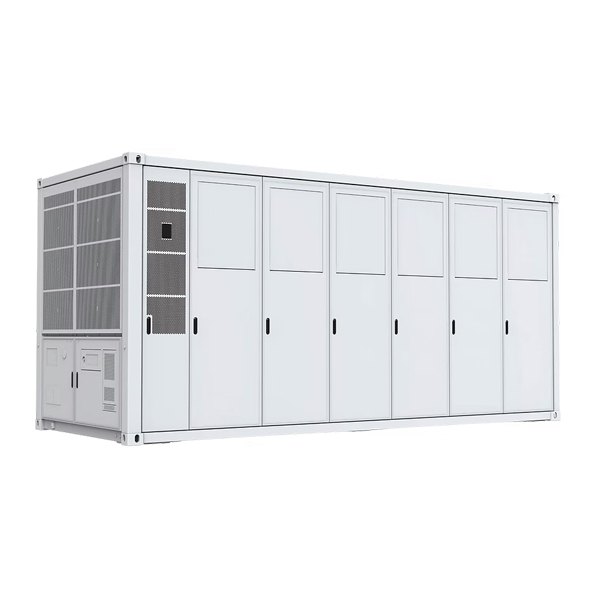
Huawei LUNA2000-2507/5015-2S: BESS storage container 2.507/5.015 MWh – 1.254/2.507 MW
Huawei liquid-cooled electrochemical storage container from the LUNA2000-2S series, built on Smart String Grid-Forming technology, designed for utility-scale storage and grid-support applications.
- Rated charge/discharge power of a 0.5 C system (1.254 or 2.507 MW depending on the system)
- Nominal energy capacity 2.507 or 5.015 MWh
- Protection degree IP55, C5-Medium anti-corrosion class
- Smart String Grid-Forming technology with ancillary grid services support (black start, voltage and frequency regulation)
Datasheet English
Complete documentation
The Huawei LUNA2000-2S storage container is a liquid-cooled BESS built on LFP cells, developed as part of the Smart String Grid-Forming ESS series for utility-scale and grid-support applications. The nominal energy capacity is 2.507 or 5.015 MWh, with a maximum DC voltage of 1,500 V.
In the 2S configuration, the charge and discharge rate is ≤0.5 C, for a rated power of 1.254 or 2.507 MW, supplied by adding the Huawei LUNA-213KTL-H0 PCS to the system.
The container, a classic 20-feet, measures 6,058 x 2,896 x 2,438 mm (W x H x D) and weighs up to 43 t.
The operating temperature range is -30°C to 55°C; the storage temperature range is -40°C to 60°C, with admitted relative humidity up to 0-100% (non-condensing).
Cooling is liquid-based, and the system integrates a dual-stage fire suppression system with water sprinklers and NOVEC 1230 agent.
The protection degree is IP55, with a C5-Medium anti-corrosion rating.
Communication runs over an Ethernet/SFP interface using the Modbus TCP protocol.
The internal battery pack uses LFP cells (104 cells per pack), with a nominal capacity of 314 Ah/104.5 kWh, IP65 protection, and a maximum pack weight of 710 kg.
The system is compliant with the standards of RoHS, IEC62477-1, IEC62040-1, IEC61000-6-2, IEC62933-5-2, UL9540A, IEC62619, and UN38.3, among others.
The LUNA2000-5015-2S operates as part of Huawei’s Smart String Grid-Forming ESS platform, which also includes the LUNA2000-213KTL-H0 PCS.
Related products
-
Storage Battery, BESS, Huawei
Huawei LUNA2000 107-215 – C&I BESS storage system with hybrid cooling
The Huawei LUNA2000-(107-215) system is the ideal solution for commercial and industrial installations that require high-capacity energy storage, scalability and maximum safety.
- Available storage capacities: 215 kWh, 161 kWh, 107 kWh
- Charging/discharging power: up to 108 kW
- LFP cells
- Maximum cycle efficiency: 3 % (@ 0.25 C)
- Protection rating: IP55
SKU: n/a -
Storage Battery, BESS, ZCS Azzurro
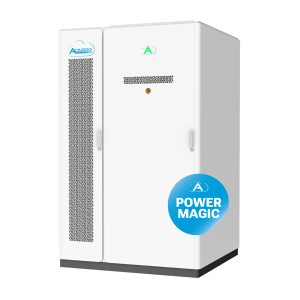
ZCS Azzurro: Power Magic – all-in-one cabinet for C&I applications
 Storage Battery, BESS, ZCS Azzurro
ZCS Azzurro: Power Magic – all-in-one cabinet for C&I applications
The outdoor retrofit Power Magic storage system is ideal for large-scale industrial installations. It can be adapted to the needs of each customer and installation is simple, thanks to the plug & play design.
- Capacity: 215 – 258 kWh
- Charge/discharge power: 125 kW
- Liquid cooling
- Integrated fire suppression system
- IP55
- Integrated EMS and monitoring
SKU: n/a -
Storage Battery, ZCS Azzurro
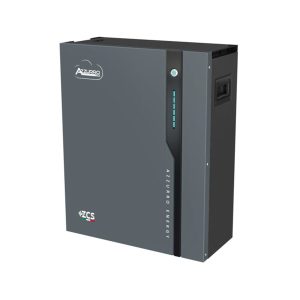
ZCS Azzurro: LV ZSX5000 PRO battery – low voltage – from 4,6 to 18,4 kWh
 Storage Battery, ZCS Azzurro
ZCS Azzurro: LV ZSX5000 PRO battery – low voltage – from 4,6 to 18,4 kWh
The ZSX5000 PRO LV battery modules are an energy storage unit for residential applications, combined with ZCS single-phase inverters.
- LFP technology
- Total net capacity (single module): 4,6 kWh
- Nominal voltage (single module): 51,2 V
- Maximum charge and discharge current: 100 A
- 10-year warranty
SKU: n/a -
Storage Battery, Pylontech
Pylontech H48050A lithium battery HIGH voltage
The Pylontech H48050A lithium battery is the module that connected in series allows to obtain storage systems with different types of working voltages and storage capacity, depending on the application. The system consists of a control module and several battery modules.
- 4.8 kWh energy for single-phase systems and 9.6 kWh for three-phase systems
SKU: n/a