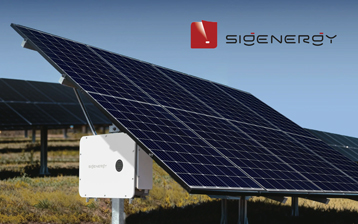
The Sigenergy Sigen PV 370H2 and Sigen PV 400H2 are string inverters designed for utility-scale photovoltaic plants and large Commercial & Industrial (C&I) applications.
The two solutions provide a rated active power of 333.3 kW and 360 kW respectively, with 14 independent MPPTs, 28 string inputs, DC voltage up to 1,500 V and 800 V AC output.
The architecture is designed to meet the requirements of large-scale PV plants, where compatibility with high-current PV modules, the management of array sections with different characteristics, and the reduction of installation and O&M costs are key considerations.
The technical data provided in this article are based on the preliminary Sigenergy datasheet and may therefore be subject to change in the final documentation.
Key features of Sigen PV 370H2 and Sigen PV 400H2
The Sigen PV 400H2 delivers a rated active power of 360 kW and a maximum apparent power of 396 kVA. It is designed for three-phase grids with a rated output voltage of 800 V.
The Sigen PV 370H2, on the other hand, provides a rated active power of 333.3 kW and a maximum apparent power of 366.3 kVA, while retaining the same DC architecture and AC voltage.
On the DC side, both inverters feature:
- 14 independent MPPT trackers;
- 2 strings per MPPT, for a total of 28 DC inputs;
- maximum input current of 40 A per MPPT;
- short-circuit current of 60 A per MPPT;
- maximum input voltage of 1,500 V;
- MPPT operating range from 480 to 1,500 V;
- start-up voltage of 520 V;
- H4 Pro connectors for direct string connection.
These characteristics make the Sigen PV 370H2 and Sigen PV 400H2 particularly suitable for the design of large-scale photovoltaic plants based on a 1,500 V DC architecture.
14 MPPTs and 28 strings for high-current PV modules
One of the key features of the new Sigenergy inverters is their architecture with 14 independent MPPTs and 28 string inputs.
The maximum current of 40 A per MPPT allows two parallel strings of PV modules with G12 cells to be connected, whose current at maximum power point can typically range between 17 and 19 A.
This makes it possible to use all 28 inputs even with high-power, high-current PV modules, an increasingly important consideration when designing large-scale PV plants.
The 14 independent trackers also provide greater flexibility when managing array sections with different orientations, tilt angles or operating conditions.
This can be particularly useful in utility-scale PV plants installed on non-uniform terrain, helping to limit mismatch losses. For this architecture, Sigenergy states a yield increase of up to 1.5% based on simulations.
Why choose Sigen PV 400H2 for MW-scale PV plants
With 360 kW of rated power per inverter, the Sigen PV 400H2 can reduce the overall number of units required in large-scale photovoltaic plants.
As an indication, approximately the following number of inverters would be required to achieve 10 MW of rated power:
- 28 Sigen PV 400H2 units;
- 30 Sigen PV 370H2 units.
The ability to connect 28 strings directly to each inverter may also reduce the need for string combiner boxes in certain system configurations, decreasing the number of terminations and potential points of failure.
The result is a potentially simpler array architecture, with benefits during both installation and subsequent maintenance activities.
800 V AC output: advantages for large-scale PV plant design
Another relevant feature of the Sigen PV 370H2 and Sigen PV 400H2 is their three-phase output with a rated voltage of 800 V AC.
The Sigen PV 400H2 has a rated output current of 259.9 A. At the same power level, using a higher voltage than traditional 400 V architectures makes it possible to reduce the current on the AC side.
For designers and EPC contractors, depending on the plant configuration, this can translate into smaller conductor cross-sections, reduced losses and optimised AC distribution between the inverters and transformer substation.
However, the system design must include a transformer with a low-voltage winding compatible with the 800 V output.
Protection and safety features of Sigen PV 370H2 and 400H2
For utility-scale photovoltaic plants, operational continuity and equipment protection are essential factors.
The Sigen PV 370H2 and Sigen PV 400H2 include the following as standard:
- DC switch;
- DC reverse-polarity protection;
- PV and output terminal overtemperature protection;
- anti-islanding protection;
- AC overcurrent protection;
- insulation monitoring;
- residual current monitoring;
- Type II SPDs on both the DC and AC sides.
Both inverters also feature an IP66 protection rating, intelligent air cooling and an operating temperature range from −30°C to +60°C.
These characteristics make them suitable for outdoor installation under the typical operating conditions of large ground-mounted photovoltaic plants.
Fault diagnostics and reduced O&M costs
In large-scale PV plants, system availability and the speed of maintenance operations have a direct impact on investment profitability.
For the Sigen PV 370H2 and Sigen PV 400H2, Sigenergy states an MPPT-level insulation fault localisation function, with a claimed resolution up to 15 times higher.
In the event of an alarm, the system can therefore identify which of the 14 MPPTs is affected by the fault.
For O&M personnel, this means that troubleshooting can be narrowed down to a smaller section of the PV array connected to the inverter, potentially reducing the time required to identify the fault.
In utility-scale plants comprising dozens of inverters, more granular diagnostics can contribute to reducing downtime and Operation & Maintenance costs.
Communication and monitoring
In terms of communication, the Sigen PV 370H2 and Sigen PV 400H2 support:
- Fast Ethernet;
- PLC (Power Line Communication) over the AC line;
- WLAN for configuration via the app;
- LED indicators for operating status display.
PLC communication allows the AC power line to be used for data transmission as well, reducing the need for dedicated communication infrastructure in certain configurations.
The preliminary datasheet used as a reference does not, however, specify an RS485 port.
Sigen PV 370H2 and 400H2 and the Central Plant Controller
For large photovoltaic plants connected to the medium-voltage grid, the requirements established by Italian regulations for the Central Plant Controller (Controllore Centrale d’Impianto – CCI) must also be taken into account.
ARERA Resolution 385/2025/R/EEL regulates the installation of the CCI and PF2 functionalities for active power regulation following commands from the Distribution System Operator, in accordance with the thresholds, deadlines and procedures established by the applicable regulations.
With the Sigen PV 370H2 and Sigen PV 400H2, the CCI remains an external device and must therefore be taken into account within the overall plant architecture.
For further information on requirements, power thresholds and deadlines, see our dedicated article on ARERA Resolution 385/2025 and the Central Plant Controller.
Sigen PV 370H2 vs Sigen PV 400H2: technical comparison
| Specification | Sigen PV 370H2 | Sigen PV 400H2 |
| Rated active power | 333.3 kW | 360 kW |
| Maximum apparent power | 366.3 kVA | 396 kVA |
| Rated / maximum output current | 240.4 A / 264.4 A | 259.9 A / 285.8 A |
| Rated AC voltage | 800 V, 3W+PE | 800 V, 3W+PE |
| Maximum DC voltage | 1,500 V | 1,500 V |
| MPPT range | 480–1,500 V | 480–1,500 V |
| MPPTs | 14 | 14 |
| DC inputs | 28 | 28 |
| Maximum current per MPPT | 40 A | 40 A |
| Maximum efficiency | 99.0% | 99.0% |
| European efficiency | 98.8% | 98.8% |
| Protection rating | IP66 | IP66 |
| Weight | 140 kg | 140 kg |
| Dimensions (W×H×D) | 1080 × 875 × 409 mm | 1080 × 875 × 409 mm |
Sigen PV 370H2 or Sigen PV 400H2: which one to choose?
The choice between the two models mainly depends on the plant capacity, planned electrical architecture and DC/AC ratio sizing.
Thanks to its 360 kW rated power, the Sigen PV 400H2 allows more power to be concentrated in each individual inverter and may therefore be particularly suitable for large utility-scale plants where optimising the number of installed inverters is a key objective.
The Sigen PV 370H2, with a rated power of 333.3 kW, retains the same configuration of 14 MPPTs and 28 DC inputs, while offering greater flexibility in system configurations where this power rating is better suited to the overall plant design.
In both cases, the combination of 1,500 V DC architecture, 800 V AC output, 14 MPPTs, compatibility with high-current PV modules and advanced diagnostics positions the new Sigenergy inverters as solutions specifically designed for large-scale utility and C&I photovoltaic plants.
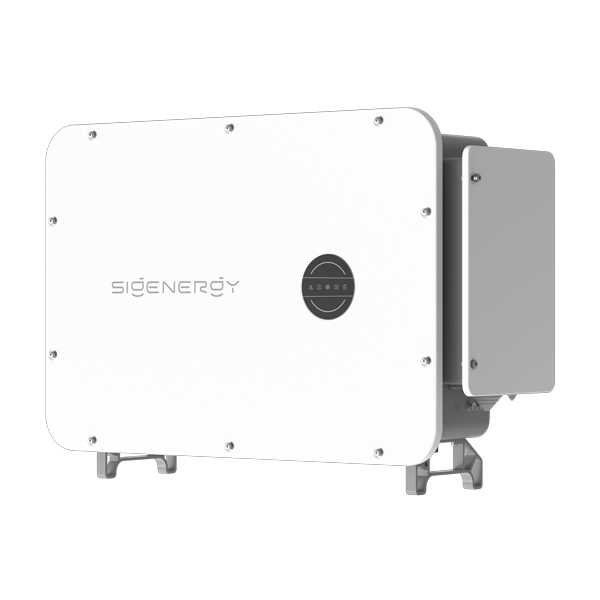
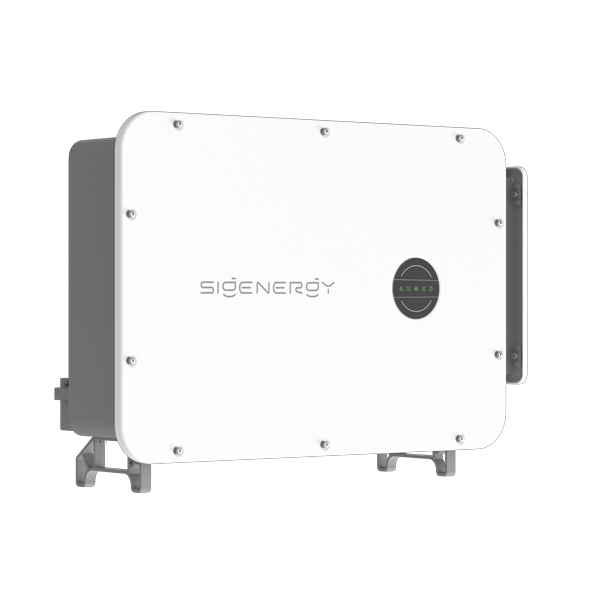
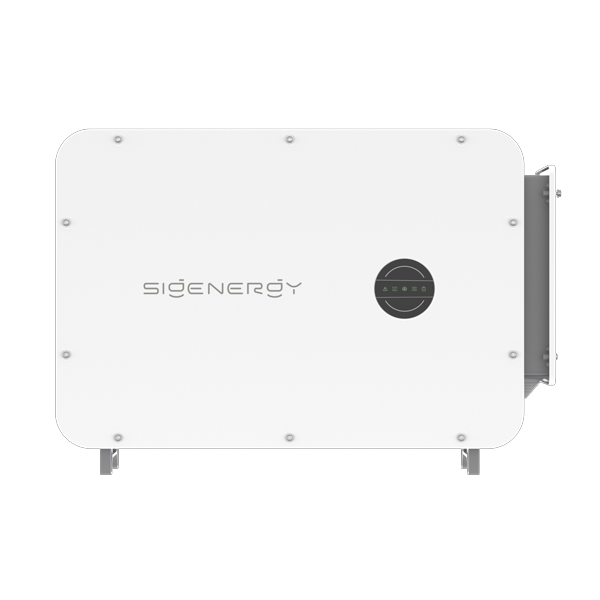
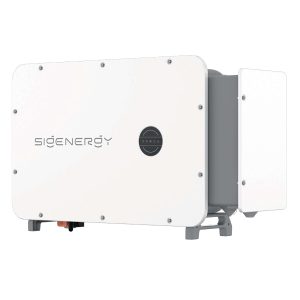
Sigenergy Sigen PV 370H2 and 400H2 – 333.3/360 kW Utility-Scale string inverters
Three-phase multi-MPPT string inverter Sigenergy Sigen PV 370H2 and 400H2, designed for utility PV installations.
- Rated power 333.3 and 360kW kW
- 14 independent MPPTs
- European efficiency 98.8%
- AC output 800 V
Datasheet English
Complete documentation
The Sigenergy Sigen PV H2 is a multi-MPPT string inverter, available both in the 333,3 kW and 360 kW version, and it is part of the Sigen Utility PV Inverter series, designed for utility-scale ground-mounted PV systems with DC voltage up to 1,500 V. The inverter features 14 independent MPPTs, each supporting up to 2 PV strings thanks to the high levels of current supported, for a total of 28 strings connectable.
On the AC side, the Sigen PV 370H2 delivers a rated output power of 333.000 W, while the Sigen PV 400H2 delivers a rated output power of 360.000 W, both with an output voltage of 800 V (3W+PE). Maximum efficiency reaches 99%, with a European efficiency of 98.8%.
Built-in safety functions include a DC switch, PV/output terminal overtemperature protection, anti-islanding protection, AC overcurrent protection, DC reverse-polarity protection, insulation monitoring, and residual current monitoring. DC surge protection is Type II as standard (Type I optional), while AC surge protection is Type II; arc-fault detection (AFCI) is available as an option.
The inverter can operate within an ambient temperature range from -30 °C to 60 °C, has an IP66 protection rating and a smart air cooling system. The anti-corrosion class is C5-M as standard (C5-H optional). Dimensions do not go over half a cubic meter, with a weight of 150 kg.
It communicates via Fast Ethernet, AC-side power line communication (PLC) and WLAN. The management is performed through a dedicated app and an integrated LED display.
Related products
-
Inverter, Photovoltaic inverter, Sigenergy, Residential inverter Sigenergy
Sigenergy SigenStor EC 3.0/12.0 SP – Single-Phase Hybrid Inverter
 Inverter, Photovoltaic inverter, Sigenergy, Residential inverter Sigenergy
Sigenergy SigenStor EC 3.0/12.0 SP – Single-Phase Hybrid Inverter
Residential, single-phase, hybrid inverter, suitable for backup functionality. Its design is intended to easily integrate with battery and EV recharging systems inside the customer installation.
- 2 MPPT
- Protection rating IP66
- All-in-One system
- Communication through: WLAN, Fast Ethernet, 4G/3G/2G (Sigen CommMod)
- Available sizes: EC3.0SP, EC4.0SP, EC4.6SP, EC5.0SP, EC6.0SP
SKU: n/a -
Inverter, Photovoltaic inverter, Sigenergy, Residential inverter Sigenergy, Hybrid inverter, Sigenergy
Sigenergy Sigen Hybrid 3.0/12.0 TP2 – three-phase
 Inverter, Photovoltaic inverter, Sigenergy, Residential inverter Sigenergy, Hybrid inverter, Sigenergy
Sigenergy Sigen Hybrid 3.0/12.0 TP2 – three-phase
Sigenergy Sigen Hybrid TP2 three-phase hybrid inverter for residential and commercial applications with a 10 years warranty. It guarantees for three-phases systems the maximum self-consumption of energy thanks to its high performances.
- 2 MPPT
- Efficiency up to 99%
- IP66
- Backup available with Gateway Sigenergy HomePro TP
- Available: 3.0TP2, 4.0TP2, 5.0TP2, 6.0TP2, 8.0TP2, 10.0TP2, 12.0TP2
SKU: n/a -
Inverter, Photovoltaic inverter, ZCS Azzurro, Commercial inverter ZCS Azzurro
ZCS Azzurro 3PH 250KTL-HV-Z0 / 330KTL-HV-Z0 / 350KTL-HV-Z0
 Inverter, Photovoltaic inverter, ZCS Azzurro, Commercial inverter ZCS Azzurro
ZCS Azzurro 3PH 250KTL-HV-Z0 / 330KTL-HV-Z0 / 350KTL-HV-Z0
The ZCS Azzurro 3PH 250KTL-HV-Z0, 330KTL-HV-Z0 and 350KTL-HV-Z0 three-phase inverters are high-power solutions designed for commercial, industrial and large-scale photovoltaic systems.
With rated power outputs ranging from 250 to 350 kW, maximum efficiency of up to 99%, DC voltage up to 1,500 V and an IP66 protection rating, they provide high efficiency, design flexibility and reliability even in demanding environmental conditions.- AC and DC surge protection, with monitoring via the ZCS Azzurro app and portal
- Up to 8 independent MPPTs for flexible PV string management
- Wide MPPT voltage range from 500 to 1,500 V, with a rated DC voltage of 1,160 V
- Maximum efficiency up to 99% and IP66 protection for outdoor installations
- Rated power from 250 to 350 kW
SKU: n/a -
Inverter, Photovoltaic inverter, Sigenergy, Commercial Inverter Sigenergy
Sigenergy Sigen PV 50/110 M1-HYB – C&I Three-Phase Hybrid Inverter
 Inverter, Photovoltaic inverter, Sigenergy, Commercial Inverter Sigenergy
Sigenergy Sigen PV 50/110 M1-HYB – C&I Three-Phase Hybrid Inverter
Three-phase hybrid inverter by Sigenergy for commercial and industrial installations provided with battery systems, potential backup and expansion functionalities available through Sigenergy’s gateway.
- 8 MPPT with powers of 100 and 110kW
- Expansion up to MW of power through multi-unit connection
- Microgrid solution to simplify the configuration and improve the performances
- Available sizes: PV50M1-HYB, PV60M1-HYB, PV80M1-HYB, PV100M1-HYB, PV110M1-HYB
SKU: n/a