Rooftop solar PV could become one of the key pillars of Europe’s energy transition. According to a new analysis conducted by the European Commission’s Joint Research Centre (JRC), rooftops across the European Union could accommodate approximately 2.3 TWp of photovoltaic capacity, potentially meeting around 40% of Europe’s future electricity demand in a fully renewable energy scenario by 2050.
This potential is particularly significant for the Commercial & Industrial (C&I) sector, where large available roof areas, self-consumption and integration with energy storage systems can transform buildings into genuine energy assets.
The potential of rooftop solar PV in Europe
The study, published in Nature Energy, uses the European Digital Building Stock Model (DBSM R2025), a high-resolution geospatial database covering approximately 271 million buildings across the European Union.
The analysis adopts a bottom-up approach, estimating photovoltaic potential at individual building level and subsequently allowing data to be aggregated across neighbourhoods, cities, regions and Member States.
According to the estimates, using current photovoltaic technologies, European rooftops could provide:
- approximately 2.3 TWp of total photovoltaic capacity;
- approximately 2,750 TWh of annual electricity generation;
- approximately 1,822 GWp on residential buildings;
- approximately 519 GWp on non-residential buildings.
This potential generation would be sufficient to meet approximately 40% of the electricity demand expected by 2050 under a European energy scenario based entirely on renewable sources.
Large C&I rooftops are strategic to achieving 2030 targets
One particularly significant finding concerns non-residential buildings.
According to the study, by 2030 more than half of European buildings with a floor area exceeding 2,000 m² could make a significant contribution towards the additional photovoltaic capacity required to meet European targets, with an overall estimated potential of approximately 355 GWp.
The rooftops of manufacturing facilities, warehouses, logistics centres, shopping centres and other large buildings therefore represent a strategic resource for accelerating photovoltaic deployment without requiring additional land use.
For installers, system designers and EPC contractors, the C&I rooftop segment also represents a major opportunity to develop projects in which solar PV, BESS energy storage systems and Energy Management Systems (EMS) are designed as an integrated solution to increase self-consumption and optimise energy management.
Solar PV and renewables: the European landscape
The growth of photovoltaic energy is taking place within a European market in which renewables now play a central role in electricity generation.
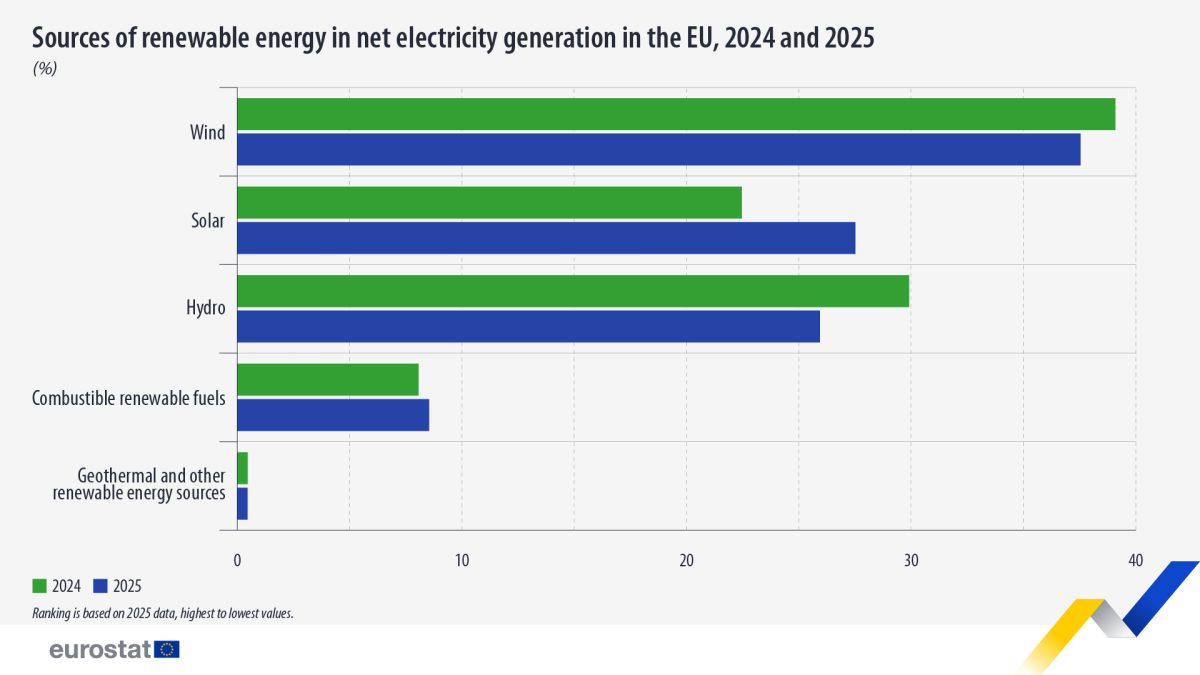
According to Eurostat, in 2025, 47.3% of the electricity generated in the EU came from renewable sources, compared with 47.2% in 2024.
Wind remained the leading renewable source, accounting for 37.5% of renewable electricity generation, while solar reached 27.5%, ahead of hydropower at 25.9%.
The most significant figure, however, concerns growth: in 2025, solar electricity generation increased by 24.6% compared with 2024, recording the highest growth rate among the main renewable energy sources.
From rooftops to energy-active buildings
The potential of rooftop solar PV extends beyond the generation of renewable electricity alone.
Integrating photovoltaic systems into buildings makes it possible to combine energy generation, storage and intelligent energy management, supporting the development of increasingly decentralised energy systems.
In particular, combining solar PV systems, battery energy storage and Energy Management technologies can increase self-consumption, enable more efficient management of load profiles and support the electrification of energy consumption, from heat pumps to electric mobility.
From this perspective, the rooftops of residential, commercial and industrial buildings can become a genuine distributed energy infrastructure.
For the professional photovoltaic market, the potential identified by the European study therefore confirms the strategic role of rooftop PV systems and, in particular, C&I applications in driving the growth of solar PV and energy storage systems over the coming years.